


Varicose veins (varicose veins) are a very common vascular disease known to humans since ancient times.It is mentioned in Ancient Egyptian papyri;a mummy was even found with signs of varicose veins on its legs.They find information on pathology in Hippocrates, Galen and Avicenna.Modern doctors also often encounter varicose veins in patients and are looking for effective treatment methods.
The term “varicose veins” is of Latin origin, the word “varice” is translated as “expansion”.This is why the disease began to be called “Varicose Veins”.With this disease the peripheral veins increase in volume, become long, tortuous, deformed and knotty.Blood pools in the lower parts of the leg because the valves begin to malfunction and the walls weaken.Most often, vascular damage is observed in the legs, since there is the greatest load on the vessels, it is necessary to pump large amounts of blood and overcome the force of gravity.
Varicose veins are diagnosed in approximately 17-25% of people.Among young people, both boys and girls are equally affected.In mature and elderly women this pathology occurs 2-3 times more frequently than in men of the same age.This is due to the constant hormonal changes in the female body that occur throughout life.
How are the veins in the legs arranged?
The legs have two groups of venous vessels: superficial and deep or deep.The former are located in the subcutaneous tissue, that is, on the surface of the leg.The latter are found deeper, in the thickness of the muscles, near the arteries and tendons.The deep and superficial vessels are connected by perforating or perforating veins.Their wall is made up of collagen and elastin fibers, with weak and few smooth muscles.
The venous wall has a three-layer structure:
- In the upper part there is the adventitia, which is composed of loose connective fibres, smooth muscle cells elongated along the walls, surrounded by small capillaries and nerves responsible for the trophism of the vessel.
- In the center is the media, made up of circular smooth muscle fibers.
- The underwear is located inside.The base of the intima is the endothelium;between its cells there are longitudinal fibers of smooth muscles. The inner shell is folded, the thickenings are opposite each other and resemble swallow's nests or patch pockets.They are called valves and are responsible for the correct direction of blood flow.
Venous valves direct blood from peripheral parts to the heart, as well as from superficial to deep veins.They prevent reverse outflow and increase venous pressure.In addition to the valves, smooth muscles, tendons and leg muscles participate in maintaining normal tone.When any of the layers (usually the middle and inner layers) are damaged, the veins lose their tone and expand, giving rise to varicose veins.
There are several superficial veins:
- The great saphenous vein is located inside the leg;its walls are equipped with numerous valves;blood from the anterior femoral surface is collected in this vein through a series of smaller vessels.
- The small saphenous vein is located on the outside of the leg, has valves, and collects blood from veins on the front and back of the leg.
Communication between large and small veins occurs through connecting vessels.
The deep veins are the posterior and anterior tibial veins, the popliteal vein, and the femoral vein. Varicose veins develop in them in advanced stages, when the disease is not treated for a long time.
For what reasons do varicose veins appear and who is at risk of getting sick?
It is difficult to say why people suffer from varicose veins at the moment.Only a few risk factors have been identified, due to which the valves weaken and the elasticity and tone of the walls of the superficial and perforating veins decrease.
Here are the factors that lead to the development of the disease:
- Inheritance.The structure of blood vessel walls is determined genetically;with some changes in the genes, they become weak and the valves do not close well.As a result, with the slightest increase in pressure in the veins, a reverse outflow of blood occurs, the vessels overflow and expand.
- Hormonal changes in the body in women. This situation is typical for pregnant women or the second half of the cycle, when the amount of progesterone increases and the level of estrogen decreases.As a result, blood rheology changes (increased coagulability), vascular tone decreases, elastin and collagen fibers are destroyed, and the risk of blood clots increases.
- Obesity.Overweight people move little, which slows blood flow throughout the body.Excess subcutaneous fat on the abdomen leads to increased pressure in the abdominal cavity and compression of the main veins.This leads to stagnation of blood in the vessels of the legs and, furthermore, varicose veins.
- Diabetes mellitus.Sugar, the level of which increases in this disease, damages the vascular endothelium, increasing the risk of blood clots.
- Alcoholism.When drinking large doses of alcohol, dehydration occurs, the blood thickens, clots form, block small blood vessels and cause congestion.
- Static professional loads, such as heavy lifting, standing or sitting work.In such a situation, muscle tone decreases, blood moves worse from the lower extremities to the heart, stagnation occurs, and the veins in the legs dilate because of this.
- Congenital blood clotting disorders.Hypercoagulation, in which too many factors responsible for the formation of clots in the blood are produced, causes thrombosis and prevents the movement of blood through the vessels.
- Wrong diet.A diet lacking in numerous vitamins (C, E, PP) and vegetable fibers leads to disorders in the structure of the endothelium and other structural elements of the vascular walls.
- Tight underwear.When you wear tight underwear, some veins get pinched, causing an obstruction of blood flow from the lower half of the body.
- Frequent constipation.People suffering from this problem have to constantly push, this increases the pressure inside the abdomen, as a result the outflow of blood becomes difficult.
- High heel.Excessive strain on the calf muscles and insufficient contraction cause blood to stagnate in the veins.
- Warm climate.In summer, during the heat, the body becomes dehydrated.If you do not compensate for the problem by drinking enough fluids, the risk of blood clots in the vessels will increase.
- Heart and kidney disorders.These can be congenital or acquired heart defects, renal failure.
- Excessive doses of drugs that affect clotting.In this case, blood vessels may become clogged with blood clots.
- Operation.The risk of thrombosis in this case increases due to blood loss and compression of the veins during the operation.
How can varicose veins be complicated?
- Thrombosis due to blood stagnation.
- Vascular thromboembolism following detachment of a blood clot.
- Thrombophlebitis or inflammation of the venous wall.
- PE (pulmonary embolism).In this case, blood flow in the pulmonary circulation is abruptly stopped, which leads to death.Small blood clots can become lodged in the small arteries of the lungs and cause a heart attack or pulmonary edema.
- Trophic ulcers, eczema on the skin of the legs due to tissue malnutrition.In case of poor blood circulation, little oxygen and nutrients enter the tissues, which impairs regeneration or causes massive cell necrosis.
- Edema syndrome.Due to impaired blood outflow and stagnation, fluid leaks through the walls of blood vessels into the intercellular space.The swelling is soft in consistency, elastic and most often appears near the affected vein, regardless of the time of day.
- Dermatitis.The inflammatory process in the skin develops due to impaired blood circulation and tissue nutrition.
- Hyperpigmentation, cyanosis of the affected areas of the skin.
- Consolidation of subcutaneous fat due to swelling and hemorrhage.
How to diagnose varicose veins
- Using functional tests (application of a tourniquet), the state of the valves is studied.They are named after the authors: Troyanov-Trendelenburg, Pratt, Sheinis, Delbe-Perthes, etc. For the Troyanov-Trendelenburg test, it is necessary to make the patient lie horizontally, then offer to raise the leg by 450. In this position, the doctor strokes the limb from the foot upwards to empty the superficial veins.The next step is to apply a tourniquet to the upper half of the thigh, after which the patient gets up from the table.Healthy leg veins should fill after 15 seconds.
- Duplex ultrasound scanning of the veins (ultrasound angioscanning) provides the most information and allows you to visualize the vessels and the blood flow through them.
- Dopplerography is a method of evaluating blood circulation through vessels.
- Phlebography or radiographic examination with contrast medium, which helps to study the internal structure of the vessel.
- Phleboscintigraphy is a technique that uses radioactive substances with further study on a special device for their distribution.
To study superficial veins, they are examined and palpated.The first three methods are used as additional tests.The last two methods are necessary to study the condition of deep or deep veins.
Treatment of varicose veins
Conservative treatment options
- Drug therapy does not cure varicose veins, but with the help of drugs the valve function, vascular trophism, blood circulation are partially improved and the risk of thrombosis is reduced.For this purpose, venotonics is used.They can be prescribed for any type of varicose veins.Ointments with nonsteroidal anti-inflammatory drugs are indicated for thrombophlebitis.Also in this situation, anticoagulants are used that effectively resolve blood clots.Treatment should be selected by a doctor, after a thorough diagnosis and taking into account the characteristics of the patient.
- Phytotherapy and additional techniques have auxiliary value.We recommend wearing compression stockings, doing gymnastics, skiing, cycling and swimming.The "bicycle" exercise in the supine position, flexion and extension of the feet, gives good results;improves blood outflow from the extremities.You can do the exercises if there are no complications. It is also recommended to take a contrast shower in the morning (first water the leg with warm water, then gradually reduce the temperature to cold). Cool baths with decoctions of oak bark, horse chestnut, chamomile, St. John's wort, skin rubbing with tincture of white acacia flowers, Kalanchoe leaves and apple cider vinegar help.Leeches help get rid of thrombophlebitis.
- Mode.You need to get out of bed slowly, 5-10 minutes.Legs should be elevated 10-15⁰ at night;to do this place a pillow under your heels.You need to walk calmly, it is undesirable to cross your legs when sitting and not overwork.All patients are advised to wear compression stockings.
- You need to eat well, include coarse fiber and vitamin-rich foods in your menu. Citrus fruits, tomatoes, rose hips, black currants, nuts, legumes, liver, onions, eggs and seafood will be useful.It is important not to drink alcohol, not to smoke and drink enough water during the day.For persistent constipation it is recommended to drink a laxative.
Surgical treatment
Phlebectomy or complete removal of the veins
The indication for such a radical operation is varicose veins, which involve a large number of veins.At the same time, there are complications: difficult-to-treat trophic ulcers, thrombophlebitis, persistent swelling in the legs, general symptoms (fatigue, dizziness, fainting).
The operation is contraindicated in cases of ischemic heart disease, serious infections, in very elderly patients, in the second half of pregnancy, in case of local inflammation of the legs (erysipelas, pustular eruptions, eczema).
Only surgery can radically free the patient from varicose veins and restore the function of the valves.If the situation is too serious, untreated and neglected, this method of treatment remains the only one.The disadvantages of the operation are the need to administer anesthesia and keep the patient in the hospital for several days under observation, postoperative trauma with scars.
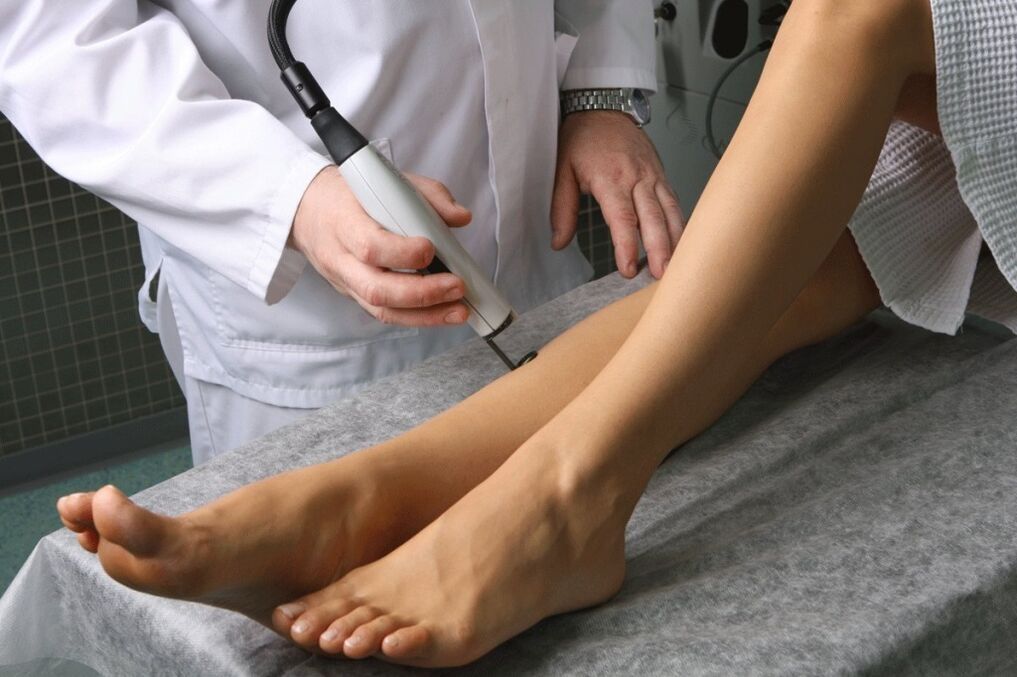
Laser therapy (endovascular microthermocoagulation)
Treatment of varicose veins with laser is used if the pathology is combined with diseases of the cardiovascular system (CHI, hypertension), changes in peripheral vessels (phlebitis, thrombophlebitis), diseases of the respiratory system (asthma, chronic bronchitis, pleurisy), pathologies of the gastrointestinal tract (cholecystitis, ulcers, peritonitis), nervous system (chronic lesions, meningitis, encephalitis and their consequences), genitourinary system (inflammation of the kidneys,prostate, pathology of the uterus with appendages), with skin diseases (furunculosis, dermatitis, psoriasis, etc.).
Contraindications to the use of laser are oncology, decompensated pathology of the kidneys, liver, heart, cerebral sclerosis, pregnancy.
The main advantages of laser therapy are the effectiveness in eliminating the dilation of superficial veins, the speed (the duration of manipulation is 15-20 minutes), the absence of the need to go to hospital and the low trauma.
Among the disadvantages, the poor accessibility of the technique should be highlighted;not all clinics have the appropriate equipment.Treatment is expensive and is of little use for deep, severely affected veins.If the laser is used incorrectly, you can get a thermal burn, and sometimes depigmentation occurs at the exposure sites.
Radiofrequency coagulation (ablation)
The operation is indicated for extensive lesions of the saphenous veins, trophic ulcers resulting from long-term and untreated varicose veins.
Radiofrequency coagulation is contraindicated in acute thrombophlebitis, limited patient mobility, pregnancy and mental disorders.
The main advantages of the method are the absence of pain, the absence of injuries and the need for hospitalization.Patients can return to normal activities the next day.
The disadvantage is the high cost of the intervention.
Sclerotherapy
Indicated for varicose veins of small and large superficial veins (on large vessels it is carried out under the control of duplex Doppler ultrasound) in the initial phase and without complications.
Pregnant and nursing mothers, drug allergies, deep vein thrombosis, infectious and inflammatory skin lesions on the legs are not treated with this method.
The main advantages are the low price, quick recovery and the absence of hospitalization.The procedure leaves no marks and does not cause injuries.
The disadvantage is the risk that the sclerosing drug penetrates into a deep vein, the reduced effectiveness in contact with the blood and the possibility of use only in the initial stages.
Is it possible to cure varicose veins at home?
At home, it is allowed to use auxiliary methods for the treatment of varicose veins, which relieve the symptoms.They use pharmacy or self-made ointments, herbal baths and lotions, compresses, drinks with decoctions and infusions to improve blood flow and relieve swelling.Below are some recipes.
Chestnut tincture
Take approximately 200 g of ripe and peeled chestnuts.Pass through a meat grinder or grind with a blender.Fill everything with a liter of vodka, put it in a dark corner and let it sit for a couple of weeks.To make the product smell nice, add a couple of drops of peppermint oil.In the evening, lubricate the legs with tincture to eliminate heaviness and itching, strengthen blood vessels and prevent their fragility.It is also recommended to make a compress from the tincture.If there is no chestnut, replace it with nutmeg, the recipe remains the same.Musk nut tincture can be used not only to rub sore feet;it is recommended to drink 20 drops per day.Once the bottle is finished, a new tincture is prepared.But there should be a gap of 2 weeks between taking the next dose.
Calendula ointment
An infusion is prepared from calendula flowers: pour a spoonful of boiling water, put on fire, cook for a couple of minutes, leave for 3 hours in a thermos.Filter the infusion and add it to some kind of fat;lanolin, petroleum jelly, badger fat are suitable.For the smell it is recommended to add a drop of aromatic oil (rose, bergamot, citrus, sage, lavender, etc.).Rub the ointment morning and evening, with delicate movements from the bottom of the leg to the knee, until completely absorbed.Thyme, hop cones and nettle are also added to the calendula infusion.
Chamomile oil
Medicinal chamomile flowers are placed in a half-liter glass jar of dark shade so that the container is filled to the top.Pour half a liter of any type of vegetable oil, for example olive, corn, hemp. Leave to act for a month, shaking or stirring occasionally.Next, the oil infusion is filtered.For scent, add a couple of drops of tea tree, mint, lavender and grapefruit aromatic oil.Apply chamomile oil to your feet early in the morning and late in the evening, performing a light massage at the same time.You can also make night compresses from the infusion.
Absinthe-based compress
Take a pack of kefir or fermented baked milk, 3 tablespoons of dried wormwood.The grass is chopped and mixed with kefir (ryazhenka).When the herb is wet, place it on cheesecloth along with a thick liquid.Then a compress is applied to the leg, covered on top with waxed paper (cellophane film is not used) and everything is fixed with several layers of bandage. Keep your legs elevated and remove the compress after half an hour.It is recommended to carry out the procedure twice a day.Instead of wormwood, you can take hops, chamomile flowers, string, clover, oak or birch leaves, St. John's wort, horsetail, tricolor violet flowers, yarrow.Combinations of different plants give a good effect.To improve the effect of the compress after the procedure, it is recommended to lie down for a while with your legs raised.All the herbs listed can be infused and used to make a foot bath.The water in such a bath should be warm, the duration of the procedure is about 25 minutes.Relieves fatigue, swelling, reduces itching and skin pain.
Traditional recipes for internal use
Various herbal infusions well improve blood flow in the veins.The following herbs are used:
- Clover
- in succession
- Leaves and berries of cranberries, viburnum, strawberries, raspberries
- Coltsfoot
- Marigold
- Japanese sophora
- Melissa
- Schisandra
- hawthorn
The herb is dried, then crushed and made into a mixture of different types of plants.Then take 3 tablespoons, pour a liter of boiling water, leave overnight in a thermos and drink 1/3 glass before meals.
Varicose veins are well treated with bee pollen and honey.Pollen should be consumed internally.Honey can also be eaten, but it still makes excellent compresses.It is recommended to add infusions of various herbs to honey.
Treatment of varicose veins in pregnant women
Carrying a child is accompanied by a hormonal storm in the female body and overload, which often causes varicose veins.Treatment during this period is carried out conservatively, using local creams, ointments and gels.
The most effective ointments have a decongestant effect and eliminate heaviness in the limbs. Apply them in a thin layer, working from bottom to top, with delicate massage movements.The frequency of manipulations is 1-3 times a day.
Folk remedies also help.It is recommended to prepare baths with herbal decoctions (of chamomile, thyme, hop cones, calendula, wormwood, coltsfoot, oak bark, birch leaves, etc.).
You can combat swelling by applying cabbage leaves or grated raw potatoes to your feet.It is necessary to cover the compress with regular waxed or thick paper, not with cellophane, so that the skin can breathe.The procedure is performed before going to sleep, and the lotion is left overnight.
Doctors also prescribe drugs for internal use to pregnant women.There are venotonics that do not negatively affect the development of the fetus and the health of the mother.They are often based on plant extracts.
After taking the drugs, the venous tone increases, the walls become elastic, they stretch less, the lymphatic flow improves, the liquid part of the blood stops leaking into the intercellular space and the swelling disappears.It is not possible to take these drugs without a prescription.
Traditional methods of treatment of varicose veins
There are many popular recipes for infusions, decoctions, lotions and compresses.It is advisable to adopt numerous remedies internally as well.Listed below are several options for treating varicose veins using traditional methods.
Lilac dye
Take a container with a volume of one and a half liters, pour lilac flowers and leaves into it.Then everything is filled with vodka or medical alcohol so that the liquid completely covers the grass (to the edge of the container).Infuse for a week, shaking occasionally, then strain and rub the tincture into your feet every day.Rub the skin with gentle massage movements, from fingers to knees.
With the help of the tincture they fight inflammation, swelling, cramps and pain in the legs.
Garlic ointment
Garlic cloves of a whole head are peeled, ground in a meat grinder or pressed through a garlic press.Next, you need to take butter (unsalted) and mix it with crushed garlic in a ratio of 1:2 (2 parts butter and 1 part garlic).Apply this mixture to the affected leg, cover with wax paper, bandage it, the compress can be kept overnight.
The compress eliminates pain and burning sensation, has antiseptic properties, softens the skin and helps heal wounds.
Honey with garlic
You need to take a head of garlic and 250 ml of honey (preferably linden or buckwheat).Both ingredients are thoroughly mixed and left for a week.Drink a spoonful three times a day, before meals.
The product relieves swelling and fatigue, pain and varicose veins become less noticeable.
Potato juice
Raw potatoes are crushed on a grater or in a blender, and the pulp is applied to the sore spots.Keep the compress for about half an hour;If you want, you can leave it on all night.To increase efficiency, drink half a glass of potato juice at the same time.The product relieves swelling and discomfort in the leg, eliminates heaviness, reduces fatigue and inflammation.
What is the effect of wearing compression garments for varicose veins?
Compression garments cannot cure varicose veins.But wearing it slows down the disease, relieves many of the symptoms caused by it and improves well-being.
After wearing compression stockings, the lumen of the saphenous veins narrows, blood and lymph flow better and do not stagnate in the limbs.At the same time, the swelling decreases, the convulsive contractions of the calves disappear, the legs are less tired and there is no feeling of heaviness.
The main types of compression garments prescribed for varicose veins are leggings, socks, hold-ups and long tights.It is recommended to wear the products every day;it is necessary to wear them in the morning, before getting out of bed, always in a lying position.
There are different degrees of compression of knitwear, they are chosen depending on the stage of varicose veins.Only the right underwear will have the right therapeutic effect.It is better to get a prescription from a doctor, but low-compression stockings or tights, for prevention, are easy to buy yourself.
Before purchasing, you need to determine exactly what compression class you need.Find out about the labeling characteristics of the chosen company's products.Reputable companies always use the word “compression” to define the class and define it in mmHg.If it says "DEN" on the package, this product has nothing to do with medical underwear.